
The signup flow was on its fifth attempt.
I made it the last one.
Cards, expenses, banking, treasury in one product.
To use any of it, you had to sign up.
And signing up was broken. Three disconnected flows. No system cohesion. Analytics that didn't work properly.
A process that took days to complete.
Every version before V5 had tried to patch it. None of them had gone far enough.
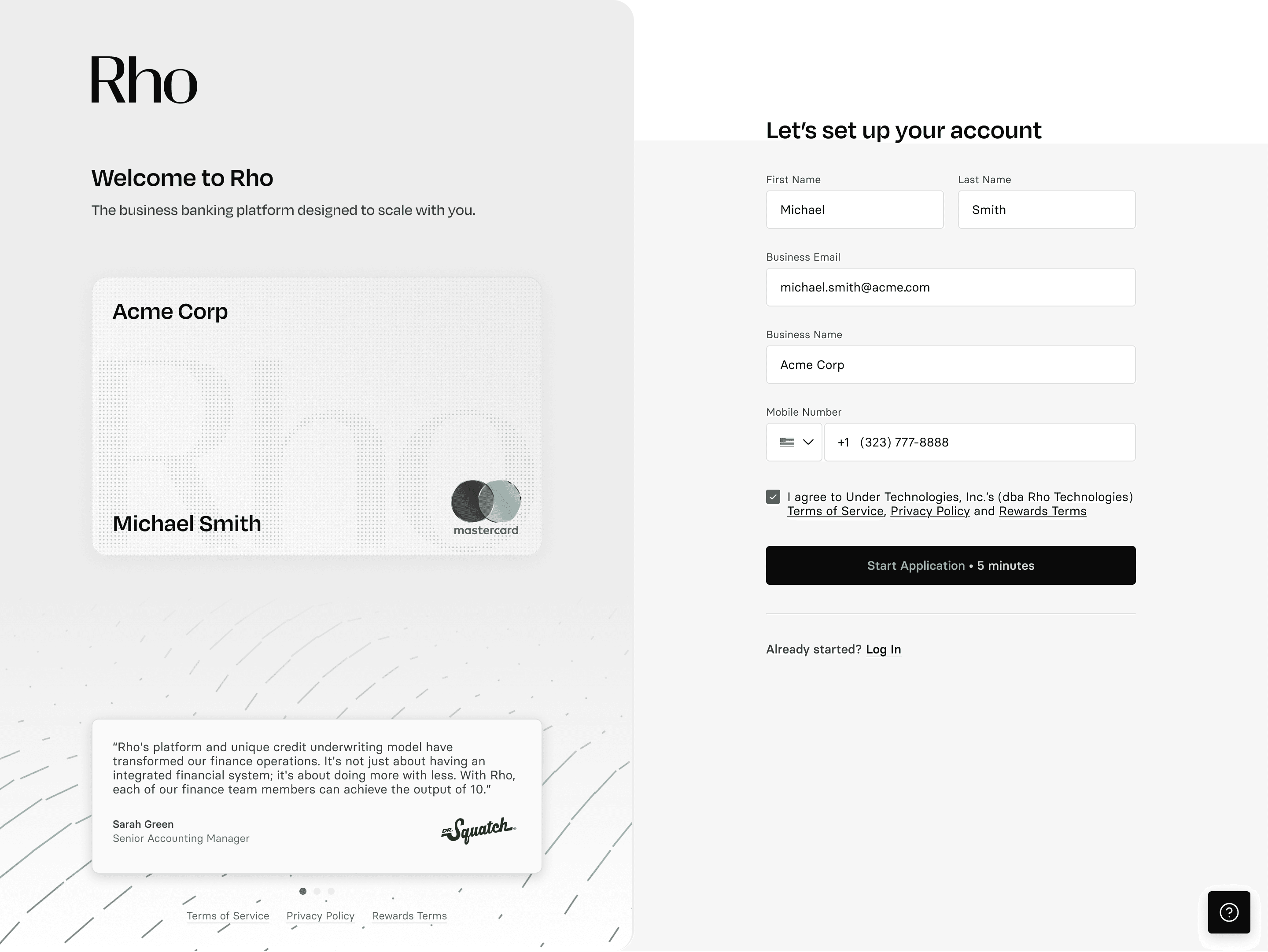
The problem was not the screens. It was that signup, fraud, compliance, and analytics had never been designed as one system. Disjointed across multiple flows, lacking cohesion. I redesigned and made them work together.
54%
90%
Start to Complete (Conversion)
16
5.5 min
Time to complete
17%
CAC Reduction
Everyone wanted a better form. I wanted an automated system.
The form was the bottleneck. It was too long, and every field was something the user had to type by hand. A shorter form would have been v6 in six months. So I went after the work itself: Clearbit enrichment, OCR, AI, automated compliance checks, and document scanning, with inline identity verification on top, all running in the background while the user moved through signup. The system did the heavy lifting. The user reviewed and confirmed what it filled in, manual entry only where legal required it. Fixing the form meant removing the form, not redesigning it.

Legal wanted language so strict it would have killed conversion. I had data. They had caution.
Our Chief Legal Officer treated every word of signup as a liability, while competitors ran cleaner, more human copy and converted at twice our rate. I brought benchmarks and conversion data, escalated to the CEO, and weeks later the language changed.
That alone drove a significant share of the lift.
Fraud and compliance, wired in
KYC, fraud signals, and compliance designed into the flow so they stopped feeling like roadblocks. I led fraud, compliance, legal, and engineering to one flow, with founders and support aligned before launch

Three ways to handle the documents
The hardest call was how hard to push on documents before letting someone finish.
I ran it as a multi-armed bandit, the company's first, with three live variants against real traffic.
One blocked submission until every document was in.
One let users finish and held the account for sales to step in while documents came later.
One let users add documents inside the flow if they had them.
Blocking lost the most people. The hold-and-follow-up version won, because most users supplied their documents within 30 days anyway. I designed compliance around how people behaved, not the safest-looking rule.

Most of the drop-off was on mobile
Every prior version lost the most users on mobile, and at the time mobile was only 20% of total traffic. That made it the real test: the flow had to stay sticky on a phone. So I built it to run unbroken on mobile. No handoffs, no interruptions, nothing that pulled the user out of the flow midway. Keep them moving on the device where they kept leaving. Within weeks of release, mobile climbed to close to 40% of all signup traffic.

What I took from it?
When something has been fixed four times, stop fixing it. The fifth attempt is not a design problem. It is a systems problem wearing a design problem's clothes.
What I'd do differently?
The flow let bad actors through too easily, and I wanted more automation to screen them at the door. Leadership chose volume, more leads, even weak ones. I'd make that case differently next time, in the language they were optimizing for, by showing what unqualified signups cost the sales team downstream rather than arguing it as a quality problem.
© 2026 · Thanks for scrolling, human